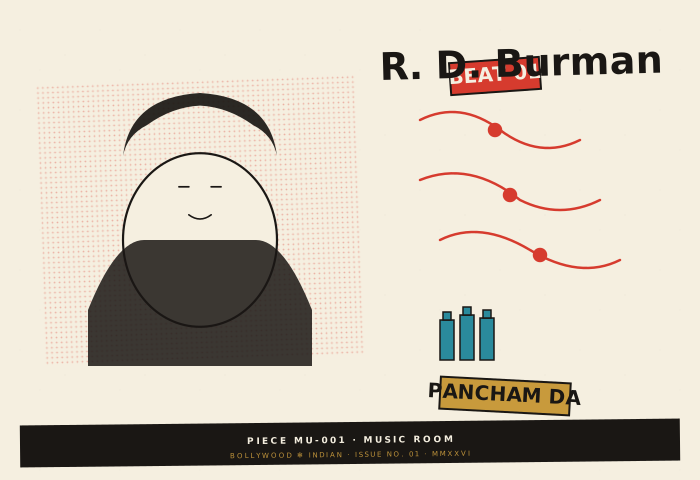
- Born: 27 June 1939, Calcutta. Son of legendary composer S. D. Burman.
- Career: 331 films across roughly three decades — from Teesri Manzil (1966) to 1942: A Love Story (1994).
- The signature: Disco-rock with Bengali folk, beer-bottle percussion, breath-as-instrument, the deepest catalogue in Hindi film music.
- Died: 4 January 1994, Bombay. Aged 54. Posthumously won his only Filmfare for 1942: A Love Story.
The most influential composer in the history of Hindi film music never won a Filmfare while he was alive. Rahul Dev Burman — known to the industry as Pancham Da and to fans as RD — composed for 331 films across three decades, redefined what an Indian film score could sound like, and was dropped by Bollywood in the late 1980s before his comeback record was released the same year he died. His story is the strangest career arc in Indian film. Here it is.
BEAT 01 The name Pancham Da
Rahul Dev Burman was born on 27 June 1939 in Calcutta to composer Sachin Dev Burman and lyricist Meera Dev Burman. The story behind his nickname "Pancham" is that as an infant, he would cry in the fifth note (pancham) of the Indian musical scale. Whether literally true or family legend, the name stuck.
His childhood was musical from day one. He began composing at age nine. His first credited tune, "Aye Meri Topi Palat Ke Aa," was used by his father in the 1956 film Funtoosh. The famous "Sar Jo Tera Chakraaye" from Pyaasa (1957) — used by his father SD Burman — was originally a young RD's composition.
He trained under the masters: classical from Ustad Ali Akbar Khan, tabla from Samta Prasad, folk and orchestration from Salil Chowdhury. Then he moved to Bombay and worked as his father's assistant for nearly a decade before getting his own break.
BEAT 02 The break — Teesri Manzil (1966)
Vijay Anand's Teesri Manzil was RD's first solo hit as a music director. The soundtrack — with songs picturised on Shammi Kapoor and Asha Parekh — was unlike anything Hindi cinema had heard. Rock and roll. Cha-cha-cha rhythms. Brass arrangements. Western pop sensibility colliding with Indian melody.
The film and the music both became massive hits. RD was 27. From that moment until the mid-1980s, he would be the most in-demand composer in Bombay.
BEAT 03 The golden decade — 1968 to 1980
Between 1968 and 1980, RD scored over 100 films. The list of soundtracks is unreasonable:
- Aradhana (1969): Music originally credited to SD Burman but RD did much of the actual arrangement.
- Kati Patang (1970): "Pyar Diwana Hota Hai," "Yeh Sham Mastani."
- Hare Rama Hare Krishna (1971): "Dum Maro Dum" — the song that put psychedelia into Hindi film music.
- Caravan (1971): "Piya Tu Ab To Aaja" — Asha Bhosle's masterclass.
- Yaadon Ki Baaraat (1973): "Chura Liya Hai Tumne."
- Sholay (1975): The most successful Hindi film score of all time. "Yeh Dosti," "Mehbooba Mehbooba" with the famous beer-bottle percussion.
- Hum Kisise Kum Naheen (1977): "Bachna Ae Haseeno," "Kya Hua Tera Wada."
- Don (1978): Title song with the famous synth bass.
- Khubsoorat (1980): "Piya Bawri."
His method was different from every composer who came before. He recorded street noises and turned them into percussion. He arranged for unusual instruments — banjos, harmonicas, autoharps. He invented sound effects with whatever was lying in the studio. The famous Mehbooba Mehbooba percussion was created by tapping empty beer bottles. The opening of "Chura Liya Hai" features RD's own glass-clinking sound.
BEAT 04 The partnership with Asha Bhosle
Asha Bhosle and RD met when she sang for his Teesri Manzil soundtrack. They began a working partnership that turned into a romantic relationship. They married in 1980.
Asha was 6 years older than RD, already an established playback singer, but had been working in the shadow of her elder sister Lata Mangeshkar. RD's compositions gave her songs that were unlike anything Lata typically sang — sensual, jazz-inflected, rhythmically complex, often pitched in registers Lata avoided. "Aaja Aaja" from Teesri Manzil. "Piya Tu Ab To Aaja" from Caravan. "Dum Maro Dum" from Hare Rama Hare Krishna. These weren't Lata-style melodies. They were songs that needed Asha's particular voice and Asha's willingness to take risks.
Together, RD and Asha redefined what a female playback singer could do in Hindi cinema. Over their careers they recorded together for hundreds of songs.
BEAT 05 The fall — late 1980s
By the mid-1980s, Hindi cinema's musical taste was changing. Producers wanted Bappi Lahiri's disco. Younger composers like Anu Malik and Anand-Milind were rising. RD's complex, jazz-influenced arrangements were starting to be seen as old-fashioned.
Then came a string of flops. Saagar (1985) was a hit, but films like Jawaani (1984), Hum Hain Lajawaab (1984), and Awara Baap (1985) all underperformed. Producers stopped calling. By 1987-89, RD — once the most in-demand composer in Bombay — was unemployed for months at a time.
It is one of the strangest career declines in Indian cinema history. The composer of Sholay and Aandhi and Khubsoorat couldn't get assignments. He developed cardiac problems. He drank heavily. The 1990 album he produced with Manna Dey, Pancham Times, was a tribute project to keep his name alive.
The composer of Sholay was unemployed by 1988. The man who invented the sound of Hindi cinema between 1968 and 1980 couldn't get a producer to return his calls.
BEAT 06 The last masterpiece — 1942: A Love Story
Vidhu Vinod Chopra approached RD in 1991 to compose for a film called 1942: A Love Story. RD agreed. The score he produced — "Ek Ladki Ko Dekha," "Kuch Na Kaho," "Yeh Safar," "Pyaar Hua Chupke Se" — was the late-career masterpiece nobody expected.
He completed the recording in 1993. The film was released in mid-1994. RD did not live to see its release.
On 3 January 1994, RD Burman suffered a heart attack at his Bombay residence. He died on 4 January, aged 54. 1942: A Love Story released six months later. The soundtrack won every major award that year — including a posthumous Filmfare for RD. It was, astonishingly, his only Filmfare Award for Best Music Director.
BEAT 07 The legacy
Almost no contemporary Hindi film composer escapes RD's influence. AR Rahman has cited him repeatedly. Shankar-Ehsaan-Loy. Vishal Bhardwaj. Pritam (who many critics accuse of directly copying RD compositions). Salim-Sulaiman. The orchestral textures, the rhythmic experimentation, the willingness to bring world music into film scores — all of it traces back to what RD did between 1966 and 1994.
His daughter Asha Bhosle remarried into the industry after his death — she continued recording into her 80s. The Burman musical dynasty — SD, RD, and Asha — covered nearly seventy years of Indian film music.
For more from the music room, read about how AR Rahman built on Pancham's legacy and Naushad's classical foundation that came before. The cinema room covers Sholay — RD's most successful score in detail.