- Released: 15 August 1975 at Mumbai's Minerva theatre.
- First-month reception: Disappointing. Trade papers predicted a flop. Several theatres in smaller cities pulled the film within 3 weeks.
- The turnaround: Word-of-mouth in metros (especially the Sholay dialogue records released by HMV) drove a second wave of viewing. By December 1975, it was profitable. By 1976, the most successful Hindi film ever.
- The legacy: Defined the masala film template — multi-genre, dialogue-driven, character-archetype-based, musically integral — that Bollywood has used for fifty years.
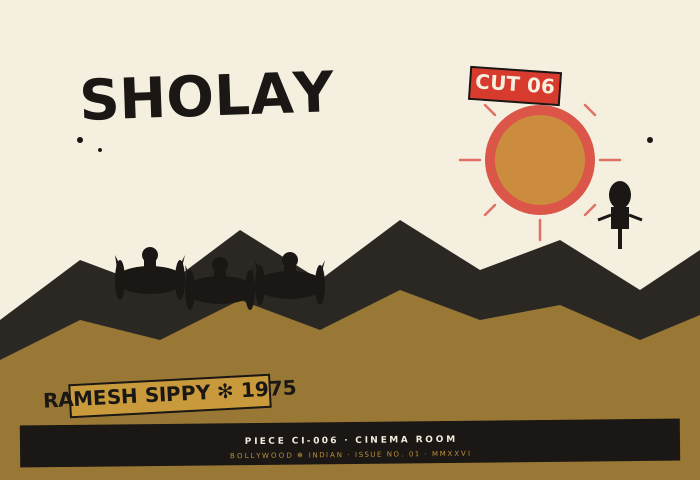
Ramesh Sippy's Sholay released on 15 August 1975. For its first three weeks, it was a commercial disappointment. By December, it had become the biggest hit Hindi cinema had ever produced. It has remained the single most influential Hindi film ever made — a film whose dialogues, characters, and musical sequences are still being referenced and parodied half a century later. Here is why Sholay still matters, what it actually does cinematically, and why it cannot be made today.
CUT 01 The setup
Director Ramesh Sippy was 26 when production began in 1973. He had directed two previous films (Andaz, Seeta Aur Geeta). His producer father GP Sippy backed a budget that was, at the time, the largest in Hindi cinema history.
The script was by Salim-Javed (Salim Khan and Javed Akhtar) — the most influential screenwriting duo Hindi cinema has ever produced. Their previous work included Zanjeer (1973) and Deewaar (1975). With Sholay they wrote what was essentially a Hindi Western: two small-time thieves (Jai and Veeru) recruited by a former police officer (Thakur Baldev Singh) to capture a bandit named Gabbar Singh.
The casting:
- Amitabh Bachchan as Jai (the silent, calculating thief).
- Dharmendra as Veeru (the loud, romantic thief).
- Sanjeev Kumar as Thakur (the wounded officer).
- Hema Malini as Basanti (the tonga-driver romantic interest).
- Jaya Bhaduri (Jaya Bachchan) as Radha (the silent widow).
- Amjad Khan as Gabbar Singh (the villain).
The script was structured as a series of self-contained set pieces — the train robbery, the Gabbar-introduction monologue, the Holi celebration, the tonga chase, the dacoit village assault, the climactic confrontation — each almost capable of standing alone.
CUT 02 The script innovations
Salim-Javed structured Sholay differently from any Hindi film before it. The dialogue was sharp, quotable, and rhythmic — designed to be memorised. Hundreds of lines became immediately quotable. Many remain in common Indian usage half a century later.
The character archetypes — the silent calculating hero, the loud romantic hero, the wounded patriarch, the terrifying bandit, the comic relief Soorma Bhopali — became templates that every subsequent multi-character Hindi film would draw from.
The Gabbar Singh character in particular was unprecedented. Amjad Khan, a stage actor with little film experience, was cast at the last minute when Danny Denzongpa dropped out. His introduction — a 7-minute monologue delivered to his own gang members about loyalty and fear — is widely considered the greatest villain introduction in Hindi cinema. Every later Bollywood villain has been measured against Gabbar.
CUT 03 The music
RD Burman composed the score. The songs — "Yeh Dosti" (the male-bonding anthem between Jai and Veeru), "Mehbooba Mehbooba" (the dacoit-camp seduction), "Holi Ke Din" (the festival sequence), "Koi Haseena Jab Rooth Jaati Hai" (the comedic romantic) — function differently from typical Hindi film songs.
They aren't romantic interludes; they're emotional load-bearing scenes. "Yeh Dosti" establishes the Jai-Veeru relationship in a way subsequent dialogue scenes can build on. "Mehbooba Mehbooba" — Helen dancing at Gabbar's hideout, percussion created by RD himself banging glass beer bottles — performs the dual function of showing Gabbar's authority and creating tonal contrast with the heroes' world.
The Sholay soundtrack was the biggest-selling Hindi film soundtrack of 1975. The dialogue record — HMV released the film's most quotable dialogues as a separate audio product — was the biggest-selling Indian non-music vinyl that year.
CUT 04 The cinematography
Dwarka Divecha shot Sholay in 70mm — only the second Hindi film to use that format. The locations in Ramanagara, Karnataka were chosen for their resemblance to the American Southwest. The terrain — rocky, dust-coloured hills — gave Sippy and Divecha the visual texture of a Western that no Hindi film had previously achieved.
Several sequences are visually iconic:
- The train robbery — minutes of action without dialogue, character introduced through movement.
- Gabbar's first appearance — silhouetted against the sky on a hilltop, his gang assembled below.
- The Thakur revelation — Sanjeev Kumar's character reveals he has no hands, shown in a single overhead shot.
- The climax confrontation — set in a dilapidated stone temple, with cross-cutting between Jai's death and Veeru's pursuit of Gabbar.
CUT 05 Why the first three weeks were a disaster
Sholay's first-month reception was extraordinarily bad. The Indian trade press predicted a major flop. Several reasons converged:
- The 70mm release pattern required specific theatres equipped for the format — only a handful in major metros had them.
- The 3-hour-15-minute runtime was considered too long.
- The competing release of Jai Santoshi Maa — a low-budget devotional film — was unexpectedly performing well.
- Critical reception was mixed; some critics called the film derivative of Spaghetti Westerns.
What turned it around was word-of-mouth, especially in metros. The dialogue record's success — kids in school memorising Gabbar's monologues — drove second viewings. By October 1975, distributors who had originally taken Sholay reluctantly were pleading for additional prints. By December, the film was profitable. By the end of 1976, it had become — and remained — the biggest Hindi film ever made.
CUT 06 The fifty-year legacy
What Sholay established that subsequent Bollywood would inherit:
- The masala genre template — action + romance + comedy + drama + music in a single film.
- The dialogue-as-product approach — Hindi cinema realised that dialogue records could sell.
- The villain-as-anti-hero — Gabbar set the template Mogambo, Shakaal, and dozens of later villains would follow.
- The supporting-character ecosystem — Soorma Bhopali, Kaalia, Sambha, Asrani's jailer — characters with brief screen time but enormous quotability.
- The multi-star-led ensemble — Bachchan, Dharmendra, Hema Malini, Sanjeev Kumar, Jaya Bhaduri all leading actors.
By the mid-1990s, the standard answer to "what's the greatest Hindi film ever made" had moved between Sholay, Pyaasa, and Mughal-e-Azam in critical surveys. Sholay still typically comes first.
Sholay defined what a Bollywood multi-genre masala film could be. Fifty years on, every multi-star action drama still works within its template, knowingly or otherwise.
CUT 07 Why it can't be made today
Several things made Sholay possible in 1975 that wouldn't replicate now:
- The 70mm format required theatre infrastructure that hasn't existed since the 1990s.
- The unhurried first hour — a 2026 audience won't accept it.
- Salim-Javed — the partnership ended in 1982 and their replacement-quality screenwriters never quite filled the gap.
- The location landscape — Ramanagara has since become a suburban extension of Bangalore. No longer feels remote.
Attempts to remake or revisit Sholay (most notably Ram Gopal Varma's Aag in 2007) have all flopped. The film exists as a singular artifact of a specific moment in Hindi cinema.
For more from the cinema room, see Guru Dutt's films that preceded Sholay's era, and Bimal Roy's social-realist tradition. The music room covers RD Burman whose Sholay soundtrack was career-defining.