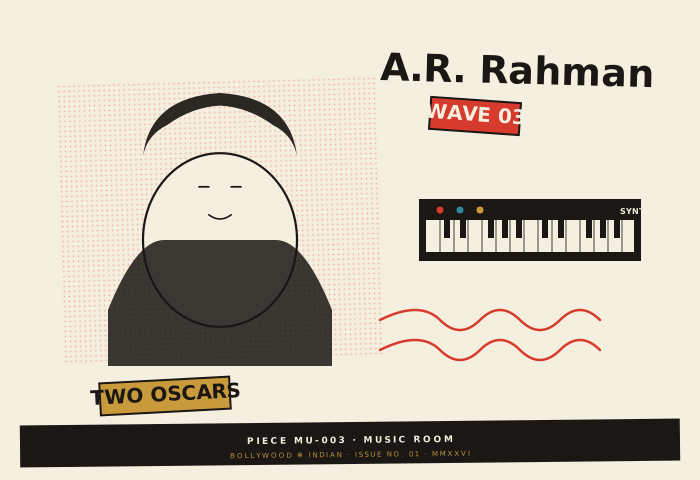
- Born: 6 January 1967 in Madras (Chennai). Originally A. S. Dileep Kumar; converted to Islam in 1989 and took the name Allah Rakha Rahman.
- Bollywood debut: Rangeela (1995). Hit immediately.
- Career stats: 100+ film scores across Tamil and Hindi cinema. 150 million records sold worldwide.
- Two Oscars: Slumdog Millionaire (2008) — Best Original Score, Best Original Song. First Asian to win both.
When Rangeela released in 1995, Hindi film music sounded different. A 28-year-old jingle composer from Madras — already a star in Tamil cinema for the previous three years — had just rewritten the rulebook. Synthesizers used as compositional foundation, not decoration. Layered backing vocals running in counterpoint. Western harmonic structures fused with South Indian classical music. Hindi cinema would never sound the same. Here is how AR Rahman changed Bollywood music permanently.
WAVE 01 The before — what Bollywood sounded like in 1994
The early 1990s Bollywood music landscape was dominated by Anand-Milind, Nadeem-Shravan, Anu Malik, and Bappi Lahiri. The sound was synth-heavy in a particular way — Roland D-50s and Yamaha DX-7 presets, drum machines on rigid beats, melodies that owed more to 1980s pop than to Hindi musical tradition.
The previous generation — RD Burman, Laxmikant-Pyarelal, Kalyanji-Anandji — had defined Hindi music through the 1970s and early 80s. By the late 1980s their style had aged out. The new style was more uniform, more formulaic, and arguably less ambitious. Songs were structured for radio plays and cassette sales rather than musical experimentation.
This was the world Rahman entered.
WAVE 02 The Tamil years — Roja (1992) onward
Mani Ratnam's Roja (1992) was Rahman's debut as music director. It was a Tamil film, not a Hindi one. But the soundtrack was so unusual that the Hindi-dubbed version became a hit across India.
What made Roja different:
- Tabla samples used as melodic instruments, not just percussion.
- Carnatic raga structures (Hamsadhwani, Mohanam) underneath what sounded like Western pop melodies.
- Layered vocal arrangements with multiple voices in harmony — rare in Indian film music at the time.
- Synth bass that didn't sound like a drum machine.
- Production quality approaching Western pop standards.
The album sold massively. Time magazine eventually listed it among the 10 best soundtracks of all time. Across his Tamil work from 1992-1994 — Bombay, Thiruda Thiruda, Kadhalan, Indian, Duet — Rahman built a sound that was new in Indian cinema.
Then Ram Gopal Varma asked him to score Rangeela.
WAVE 03 Rangeela (1995) — Bollywood meets Rahman
Rangeela was Rahman's first Hindi film. The story was modest — a Bombay girl wants to be an actress, a tapori is in love with her. But the music was a sensation.
- "Tanha Tanha" — Asha Bhosle, age 62, singing in registers and rhythms she hadn't tried before.
- "Rangeela Re" — title song with a synth bass groove unlike anything in Hindi cinema.
- "Yaaron Sun Lo Zara" — a duet with vocal layering that genuinely surprised listeners.
- "Pyar Yeh Jaane Kaisa" — straightforward romantic song made spectacular by orchestral arrangements.
The album sold 70 lakh cassettes — at a time when 30 lakh was a major hit. Asha Bhosle, then 62 and largely retired from playback singing, started a late-career comeback purely on the strength of Rangeela. She would record some of her finest work with Rahman across the next decade.
WAVE 04 The signature sound — what makes it Rahman
Across the next two decades, certain elements became identifiable Rahman trademarks:
Layered vocal arrangements
Where most Hindi film songs had one lead voice plus optional backing chorus, Rahman would often have 3-5 voices running simultaneously — each with its own melody, harmonising or counter-pointing the lead. "Maa Tujhe Salaam" (Vande Mataram album) uses 12 vocal layers. "Chaiyya Chaiyya" (Dil Se, 1998) has Sukhwinder Singh's lead against multiple female backing voices.
Counter-melodies in unusual instruments
Where another composer might have a sitar following the vocal melody, Rahman would give the sitar its own independent melody that intertwined with the vocal. The bansuri (flute) lead in "Dil Se Re." The shehnai counter-melody in "Maa Tujhe Salaam."
Long-form song structures
Rahman's songs often run 7-9 minutes when other composers stick to 4-5. "Dil Se Re" is 8:25 long. The instrumental "Jiya Jale" features extensive solo passages. He treats film songs as miniature symphonies rather than radio singles.
Synth strings + acoustic instruments together
His scores often pair carefully sampled synthesizer strings with live acoustic players. The combination has a richer texture than either alone.
WAVE 05 The Hindi years — major scores
- Bombay (1995) — instrumental score that won universal acclaim.
- Dil Se (1998) — Mani Ratnam Hindi film. "Chaiyya Chaiyya" sequence became iconic.
- Taal (1999) — Subhash Ghai. "Taal Se Taal Mila" used carnatic taals as foundation for radio-friendly pop.
- Lagaan (2001) — Ashutosh Gowariker. Oscar-nominated. Eight song-and-dance numbers, each tied to a moment in the cricket-match plot.
- Saathiya (2002) — Vishal Bhardwaj wrote lyrics; Rahman composed.
- Swades (2004) — "Yeh Tara Woh Tara," "Yun Hi Chala Chal."
- Rang De Basanti (2006) — "Tu Bin Bataye," "Khalbali."
- Jodhaa Akbar (2008) — "Jashn-E-Bahaaraa," "Khwaja Mere Khwaja."
WAVE 06 Slumdog Millionaire (2008) — the Oscar
Danny Boyle's Slumdog Millionaire was a British-Indian co-production. Rahman composed the score. The film won 8 Academy Awards including Best Picture. Rahman personally won two: Best Original Score and Best Original Song (for "Jai Ho").
He became the first Asian to win both Oscars in the same ceremony. The win marked Indian film music's entry into Western cultural mainstream. After 2009, Rahman would compose for Hollywood productions (127 Hours, Couples Retreat), British theatre productions (Bombay Dreams, The Lord of the Rings musical), and major international collaborations.
Roja (1992) sold millions. Slumdog (2008) won Oscars. Between those two soundtracks, AR Rahman taught Bollywood that film music could be both popular and ambitious at once.
WAVE 07 The influence on contemporary Bollywood
Nearly every major Bollywood composer who emerged after 1995 worked in the musical landscape Rahman built:
- Shankar-Ehsaan-Loy — adopted Rahman's layered orchestral approach.
- Vishal-Shekhar — adopted his fusion of Western pop with Indian melodic structures.
- Pritam — adopted his synth-strings textures.
- Amit Trivedi — adopted his long-form song structures.
- Sneha Khanwalkar — adopted his folk-music-as-foundation approach.
Today's Bollywood music scene exists in a post-Rahman world. The high-production-quality, layered, harmonically sophisticated sound that defines current films traces directly to the door he opened in 1995.
For more from the music room, read about RD Burman whose experimental approach paved Rahman's way and Lata's 1960s songs that defined the singer-composer template Rahman would later transform.