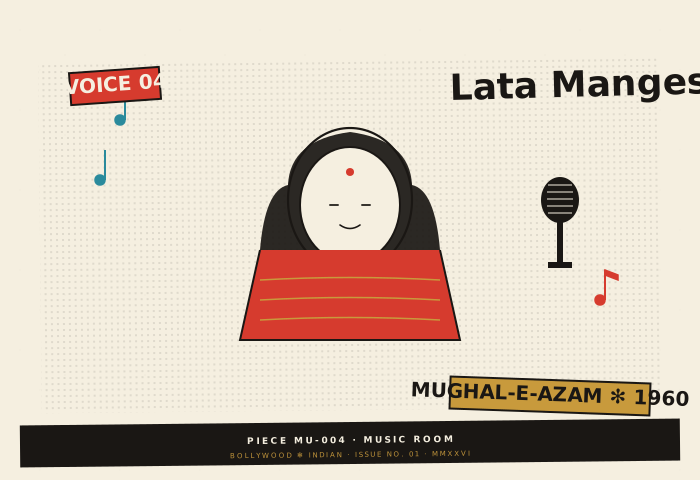
- The decade: 1960-1969 was Lata Mangeshkar's most prolific and arguably her finest. She was 31 at the start, 40 at the end.
- The composers: Naushad, SD Burman, Madan Mohan, Shankar-Jaikishan, Salil Chowdhury, RD Burman (his debut), Kalyanji-Anandji, Roshan, Khayyam, OP Nayyar.
- The films: Mughal-e-Azam (1960), Anpadh (1962), Bandini (1963), Sangam (1964), Guide (1965), Anita (1967), Aradhana (1969).
- The dominance: By 1965, more than half of all major Hindi film songs released were sung by her.
Across her seventy-year playback career, Lata Mangeshkar recorded thousands of songs. Most lists of her "greatest hits" pull from across decades — a song from 1955, one from 1972, another from 1989. This is the wrong way to listen. Lata's voice was different at different points in her career; her interpretive choices changed; her composers and the demands they placed on her shifted. The decade where her voice was at peak, her output was densest, and her partnerships with composers most varied was the 1960s. Here is a guide to that decade for newcomers.
VOICE 01 Mughal-e-Azam (1960) — the year zero
K. Asif's Mughal-e-Azam released in August 1960 after fourteen years of production. Lata recorded all five major female songs in the film, all composed by Naushad.
"Pyar Kiya To Darna Kya" is the most famous of these — picturised on Madhubala dancing in Anarkali's chamber, recorded with Lata standing in an actual marble bathroom to capture the Sheesh Mahal's echo effect. The song became and remains one of the most recognised Hindi film songs ever.
But the rest of the score is equally important:
- "Bekas Pe Karam Kijiye" — a devotional ode in Raga Kedar.
- "Mohe Panghat Pe" — a traditional thumri arrangement.
- "Teri Mehfil Mein Kismat" — a qawwali-style duet with Shamshad Begum.
- "Jab Pyar Kiya To Darna Kya" — the centerpiece, with Naushad's full operatic orchestral arrangement.
Mughal-e-Azam established the 1960s template: Lata recording across raga-based devotional songs, lyrical romantic songs, qawwali duets, and Western-orchestral romantic anthems. She would do all of these throughout the decade.
VOICE 02 The Madan Mohan partnership
If RD Burman was the great male collaborator of her career, Madan Mohan was the composer who got Lata's most emotionally complex work in the 1960s. He was known for melancholy compositions — ghazals and slow love songs — and his preferred singer for almost all of them was Lata.
Key Madan Mohan-Lata songs from the 1960s:
- "Lag Ja Gale" (Woh Kaun Thi, 1964) — sung in Raga Pahadi, became the definitive 1960s romantic ballad.
- "Nainon Mein Badra Chhaye" (Mera Saaya, 1966) — slow ghazal-influenced arrangement.
- "Aapki Nazaron Ne Samjha" (Anpadh, 1962) — soft, melancholic.
- "Sapno Mein Agar Mere" (Heer Ranjha, 1970) — a year past the decade but produced during this peak partnership.
Madan Mohan died in 1975 at age 51 — a career cut short. His work with Lata in the 1960s represents some of her most enduring recordings.
VOICE 03 The SD Burman classics
SD Burman was the composer who shaped many of Lata's most emotionally subtle 1960s performances. The Bimal Roy collaborations — Bandini, Sujata — gave her songs that needed quietness and restraint rather than vocal display.
Essential SD-Lata 1960s songs:
- "Mora Gora Ang Lai Le" (Bandini, 1963) — Bimal Roy's heroine, played by Nutan, sings to a moonlit night.
- "Aaj Sajan Mohe Ang Laga Lo" (Pyaasa, 1957) — released just before the decade but defines the SD-Lata sound.
- "Gata Rahe Mera Dil" (Guide, 1965) — a duet with Kishore Kumar, lighter and more playful than typical SD work.
- "Piya Tose Naina Lage Re" (Guide, 1965) — Lata's classical-influenced performance in Raga Mishra Pilu.
VOICE 04 The Shankar-Jaikishan peak
Shankar-Jaikishan composed for the Raj Kapoor films of the era. Their songs for Lata tended to be lush, orchestrally rich, often featuring large string sections and Western-style choruses.
Highlights:
- "Yeh Mera Prem Patra" (Sangam, 1964) — picturised on Vyjayanthimala.
- "Aaj Phir Jeene Ki Tamanna Hai" (Guide, 1965) — actually composed by SD Burman but listed here for completeness on Vyjayanthimala-on-screen songs.
- "Bole Re Papihara" (Guddi, 1971) — at the edge of the decade.
- "Suno Sajna" (Aaye Din Bahaar Ke, 1966).
VOICE 05 The Aradhana moment (1969)
Shakti Samanta's Aradhana released in late 1969. The film was a hit. The soundtrack — credited to SD Burman with significant arrangement contributions from his son RD — sold massively. Lata's contributions included "Bagon Mein Bahar Hai" (with Mohammed Rafi) and "Chanda Hai Tu Mera Suraj Hai Tu."
Aradhana sits at the end of the 1960s but it points forward to the 1970s sound. The string arrangements are denser. The percussion is more rhythmically complex. RD Burman's fingerprints are everywhere. Lata adapted to the new sound — her vocal performances on Aradhana show her flexibility going into the next decade.
VOICE 06 The singing voice that defined the decade
Lata's 1960s vocal qualities:
- Three-octave range at full command.
- Pure tonal quality — minimal vibrato, very clear pitch.
- Crystalline diction — every word audible regardless of tempo or pitch.
- Restrained emotional delivery — she rarely "performed" emotion; the song's emotional weight came from melodic and lyrical choices rather than vocal acrobatics.
This combination is what made her the dominant singer of the era. She could deliver a Mughal-e-Azam-style operatic passage and a soft Madan Mohan ghazal in the same week without obvious adjustments to her approach. Her voice was a precision instrument.
By 1965, more than half of all major Hindi film songs released that year were sung by Lata Mangeshkar. The 1960s wasn't her best decade by accident.
VOICE 07 A starter playlist for newcomers
If you want to understand 1960s Lata in 10 songs, listen in this order:
- "Pyar Kiya To Darna Kya" (Mughal-e-Azam, 1960) — the establishing song.
- "Mora Gora Ang Lai Le" (Bandini, 1963) — quiet, restrained, SD Burman.
- "Lag Ja Gale" (Woh Kaun Thi, 1964) — Madan Mohan's masterpiece.
- "Piya Tose Naina Lage Re" (Guide, 1965) — classical-influenced.
- "Aaj Phir Jeene Ki Tamanna Hai" (Guide, 1965) — different mood, same film.
- "Aapki Nazaron Ne Samjha" (Anpadh, 1962) — slow Madan Mohan.
- "Sajna Saath Nibhana" (Aaye Din Bahaar Ke, 1966) — Shankar-Jaikishan lush style.
- "Tere Mere Sapne" (Guide, 1965) — duet with Mohammed Rafi.
- "Nainon Mein Badra Chhaye" (Mera Saaya, 1966) — late-decade Madan Mohan.
- "Chanda Hai Tu Mera Suraj Hai Tu" (Aradhana, 1969) — closing the decade.
For more from the music room, see Naushad's films where Lata recorded many of her finest 1960s songs, and RD Burman's debut work where she finished the decade. The cinema room covers Bimal Roy's films where SD Burman composed much of her best slow work.