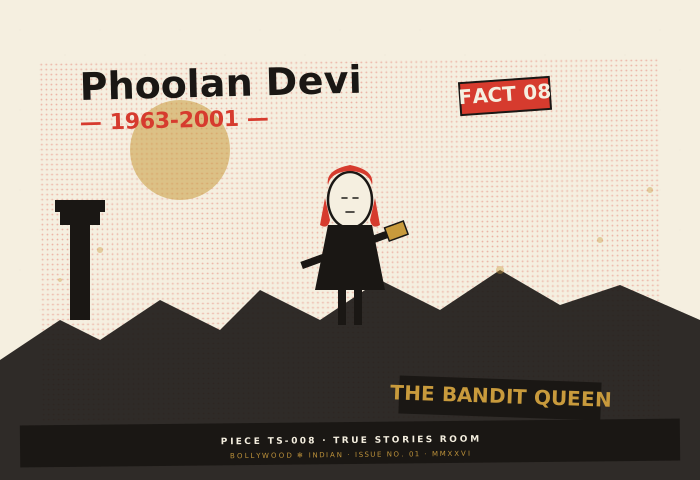
- Phoolan Devi: Born 10 August 1963 in Gorha Ka Purwa, Uttar Pradesh. Killed 25 July 2001 in Delhi.
- The film: Bandit Queen (1994), directed by Shekhar Kapur. Starring Seema Biswas. Banned briefly, then released after Supreme Court intervention.
- The Behmai incident: 14 February 1981. The event that made Phoolan Devi a national figure.
- The surrender: 12 February 1983. Negotiated terms with Madhya Pradesh state government.
- Parliament: Lok Sabha MP from Mirzapur, 1996-1998 and again from 1999 until her assassination in 2001.
Shekhar Kapur's 1994 film Bandit Queen brought Phoolan Devi's story to international attention. The film won three National Awards and was India's entry to the Oscars that year. Phoolan Devi herself initially supported the film, then disowned it publicly, attempted (unsuccessfully) to have it blocked, and remained in conflict with Shekhar Kapur for the rest of her life. Twenty years after her assassination, the gap between the film's version and the real woman's life is still being argued. Here is what actually happened.
FACT 01 The early life
Phoolan Devi was born on 10 August 1963 in Gorha Ka Purwa village, Jalaun district, Uttar Pradesh. Her family belonged to the Mallah caste — a community traditionally classified as Other Backward Class, though the gap between Mallahs and the upper-caste Thakurs of the area was severe enough that the family lived in conditions closer to lower-caste poverty.
Her father was Devidin Mallah, a small landholder. The family had a long-running dispute with their cousin Maiyadin over inheritance of about 1 acre of land. Phoolan, who from age 8-9 worked alongside her father and confronted Maiyadin publicly several times, became a target of the family's enemies early.
She was married at age 11 to a man in his thirties named Putti Lal. She left him within a year — a rare act in the rural UP context — and returned to her parents' village. From around age 13, she lived in a state of social marginalisation that would become extreme by her late teens.
FACT 02 The kidnapping (1979)
In 1979, when Phoolan Devi was approximately 16, she was kidnapped from her village by a dacoit gang led by Babu Gujjar. The exact circumstances are disputed — some sources say she was kidnapped by villagers and handed over; others say the gang directly seized her. What is established is that she lived in the gang's hideouts in the Chambal ravines for approximately the next two years.
Babu Gujjar was an upper-caste (Gujjar) gang leader. He subjected Phoolan to repeated abuse. In 1980, he was killed in an internal gang dispute — reportedly by a deputy named Vikram Mallah, who belonged to Phoolan's Mallah caste and had been protecting her from Gujjar's worst treatment.
Phoolan and Vikram Mallah became close. By most accounts they were in a relationship; by some accounts they married in a ceremony at a temple in the ravines. Vikram took over leadership of what now became the Mallah-dominated faction of the gang. Phoolan, then 17, became increasingly involved in gang operations.
FACT 03 The Behmai massacre (1981)
On 14 February 1981, Phoolan Devi's gang attacked Behmai village in Kanpur Dehat district, UP. Twenty-two upper-caste Thakur men were lined up and shot dead. The incident became the defining event of Phoolan's notoriety and of her status as a folk symbol of lower-caste resistance.
The motive remains contested. The version Phoolan herself eventually gave: she was seeking revenge against Thakur men who had killed her partner Vikram Mallah and gang-raped her in Behmai village. The version held by the families of the dead: the attack was indiscriminate caste violence by a dacoit gang. The actual sequence of events on 14 February remains in dispute.
After Behmai, Phoolan became the most-wanted person in India. The UP and MP governments mobilised large police operations against her gang. She continued operating in the Chambal ravines for the next two years, evading capture.
FACT 04 The surrender (1983)
By late 1982, Phoolan Devi's health was deteriorating and her gang was being steadily reduced by police operations. Her brother Shiv Narayan and the journalist Jaya Jaitly (then working on Phoolan's case) negotiated with the Madhya Pradesh government for terms of surrender.
The terms negotiated by Madhya Pradesh CM Arjun Singh's government were unusual:
- No death penalty.
- Maximum 8-year sentence.
- Custody to be held in MP, not UP (UP had outstanding Behmai charges).
- Her family to be given land and financial support.
On 12 February 1983 — almost exactly two years after Behmai — Phoolan Devi surrendered to MP police at Bhind, in a public ceremony attended by 10,000 people. She handed over her rifle to images of Durga and Mahatma Gandhi.
She spent the next 11 years in jail.
FACT 05 The Bandit Queen film (1994)
While Phoolan was in jail, journalist Mala Sen wrote a biography called "India's Bandit Queen: The True Story of Phoolan Devi" (1991). Shekhar Kapur acquired film rights and began work on the adaptation.
The film was shot in 1993 in the actual Chambal ravines where Phoolan had operated. Seema Biswas, a stage actress, played Phoolan. The cast was largely unknown. The film was released in 1994.
It immediately became controversial. Phoolan Devi, who had been released from jail in 1994, watched the film and publicly denounced it. Her objections were specific:
- The rape scenes were depicted explicitly in ways she said she had not consented to.
- Certain narrative claims — that she had been gang-raped at Behmai and that this motivated the massacre — she said the film had presented as fact when she herself had not given this account.
- The film's portrayal of her relationship with Vikram Mallah she felt was reductive and exploitative.
- The release rights — she said her consent to the film had been obtained through pressure and that she had not been adequately compensated.
She filed a case to block the film's Indian release. The Bombay High Court initially blocked it. The Supreme Court eventually allowed release with certain edits. The film won three National Film Awards including Best Hindi Film and went on to international festival success.
FACT 06 The political career (1996-2001)
After her release, Phoolan Devi joined the Samajwadi Party. In 1996, she contested the Mirzapur Lok Sabha seat in UP and won. She became Member of Parliament representing one of the most upper-caste-dominated constituencies in India — defeating a BJP candidate by a substantial margin.
In Parliament, she focused on rural infrastructure, women's safety, and Dalit-OBC welfare issues. She lost the 1998 election but won again in 1999, beginning her second Lok Sabha term.
Her political identity was complicated. She was a lower-caste icon for many; for the upper-caste Behmai victims' families and their political allies, she was an unrepentant mass murderer who had escaped justice through a special political deal.
FACT 07 The assassination (25 July 2001)
On 25 July 2001, Phoolan Devi was shot dead outside her residence at 44 Ashok Road, New Delhi. She was 37. Three masked gunmen approached her as she stepped out of her car returning from Parliament. She was shot nine times.
The principal accused was Sher Singh Rana, a Rajput from Roorkee, who was apprehended a few days later. Sher Singh Rana said in his eventual statement that he had killed Phoolan Devi to avenge the Behmai massacre — which had killed 22 Thakurs, his caste.
The trial took 13 years. In 2014, Sher Singh Rana was convicted and sentenced to life imprisonment by a Delhi court. The conviction has been appealed.
The most photographed dacoit-turned-MP in Indian history was assassinated on a Delhi street in broad daylight. The trial took thirteen years. The full story of who ordered the killing has never been established.
FACT 08 What the film got right and wrong
What Bandit Queen got right (per multiple sources):
- The general arc of her life — child marriage, kidnapping by dacoits, rise to gang leadership, surrender, imprisonment.
- The brutality of the Chambal ravine dacoit culture.
- The caste dynamics underlying the violence.
- The early-1980s North Indian rural political context.
What is contested or disputed:
- The Behmai motivation — whether the massacre was specifically revenge-motivated as the film claims.
- The graphic rape sequences — Phoolan said these were partially fabricated for cinematic effect.
- The portrayal of Vikram Mallah as her one true love.
- The film's representation of her consciousness and motivation during the gang years.
The deeper question — whether a film about a living person's traumatic life can be made ethically without the subject's full ongoing consent — was never satisfactorily resolved during her lifetime.
For more from the true stories room, see the Mary Kom biopic where the subject also had reservations, and Dangal's relationship with the real Phogat family. The cinema room explores how Indian directors have approached real-life subjects historically.