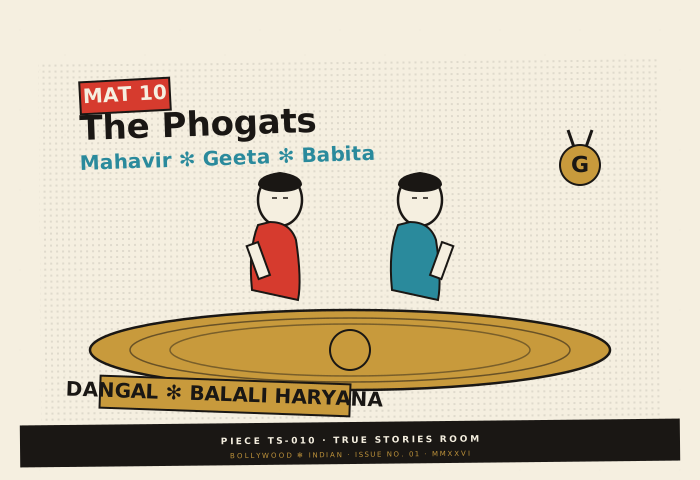
- The family: Mahavir Singh Phogat (father). Geeta Phogat, Babita Phogat, Ritu Phogat, Sangeeta Phogat (his four daughters). Cousins Vinesh Phogat and Priyanka Phogat also trained at the same facility.
- The village: Balali, Bhiwani district, Haryana. Population around 4,000 at the time the film was made.
- The film: Dangal (2016). Directed by Nitesh Tiwari. Starring Aamir Khan as Mahavir Phogat. Box office: ₹2,000+ crores globally — one of the highest-grossing Indian films ever.
- The Commonwealth gold: Geeta Phogat won India's first ever women's wrestling Commonwealth Games gold at Delhi 2010 — the climax the film is structured around.
Aamir Khan's 2016 Dangal earned over ₹2,000 crores worldwide, making it one of the highest-grossing Indian films ever made. It was based on the Phogat family of Balali village in Haryana — wrestler father Mahavir Singh Phogat training his daughters Geeta and Babita to win Commonwealth gold. The film became a cultural phenomenon. Like Mary Kom two years earlier, it took some real liberties. Here is what actually happened in the Phogat family, and what the film changed.
MAT 01 The family
Mahavir Singh Phogat was born in 1958 in Balali, a small village in Bhiwani district of Haryana. He came from a family with a wrestling background. He was a competitive wrestler in his youth, competing at the National Wrestling Championships in the 1980s. He never made the Indian national team. His own competitive career ended without major success.
He had four daughters with his wife Daya Kaur: Geeta (born 1988), Babita (born 1989), Ritu (born 1995), and Sangeeta (born 1998). He had no sons. In rural Haryana of the 1990s, this was a source of significant social pressure on the family.
Mahavir's decision — to train his daughters as wrestlers, despite the absence of any women's wrestling tradition in India at the time — was made in the late 1990s. He has said in interviews that he saw potential in his daughters from age 7-8 onwards, and that he was determined that the absence of sons would not prevent his family from continuing the wrestling tradition.
MAT 02 The early training years (2000-2009)
Mahavir set up a training pit in the family's house compound. The girls trained before dawn every day, did farm work and household work during the day, attended school, and trained again in the evening.
The training was severe. The film depicts this accurately. Mahavir cut Geeta and Babita's hair short, restricted their diet, and isolated them socially from peers who might draw them away from training. Sangeeta Phogat (the youngest) has said in later interviews that the regime was harder than the film showed.
The Haryana social context made everything more difficult. Khap Panchayat-style village authorities and conservative neighbours objected to:
- Girls being trained in physical contact sport.
- Girls wearing wrestling shorts.
- Girls' hair being cut short.
- Girls competing publicly against boys (which Geeta and Babita did in their early years, due to no women's competitions being available).
Mahavir was, by the family's own accounts, ostracised by parts of his village community for several years over these decisions.
MAT 03 Geeta Phogat's international breakthrough
Geeta Phogat won her first major international title at the 2009 Commonwealth Wrestling Championships in Jalandhar — gold in the 55 kg category. She was 21.
The truly historic moment came one year later. At the Commonwealth Games Delhi 2010, Geeta Phogat won India's first-ever women's wrestling Commonwealth Games gold medal, in the 55 kg freestyle category. This is the moment Dangal is structured around as its climax.
What the film accurately portrays:
- Geeta defeating Australia's Emily Bensted in the final.
- The match being closely contested.
- The cultural significance — a woman from rural Haryana, trained by her father in a backyard pit, beating professionally-trained international competitors.
What the film adjusts for narrative effect:
- The "father locked out of the stadium" sequence — Mahavir was at the arena and watching, though he was not always seen on broadcast camera. The film's depiction of him being deliberately excluded by the national coach is dramatic exaggeration.
- The "antagonistic national coach" character — based loosely on real coaching tensions but compressed and intensified.
MAT 04 Babita Phogat's continued success
Babita Phogat — Geeta's younger sister, born in 1989 — followed her into international wrestling. She won gold at the Commonwealth Games in 2014 (Glasgow, 55 kg category). She won bronze at the 2012 Commonwealth Wrestling Championships and silver at the 2013 World Wrestling Championships.
Babita's career arc was perhaps even more international than Geeta's. She competed at the 2016 Rio Olympics (without medalling) and remained in active competition into 2020.
The film treats Babita as essentially a secondary character — Geeta's younger sister and training partner. The reality is more complex: Babita's career achievements are comparable to Geeta's in many ways.
MAT 05 What the film got right
- The general arc — Mahavir's decision to train his daughters despite social opposition; the early-morning training regime; the lack of women's wrestling infrastructure; the Khap-style village resistance; the Commonwealth Gold climax.
- Geeta's victory at Delhi 2010.
- The Haryana cultural context — gender expectations, the wrestling tradition, the village social dynamics.
- Mahavir's specific training methods and philosophy.
- The financial difficulty of the early years.
- The diet restrictions and hair-cutting decisions.
MAT 06 What the film got wrong or simplified
- The national coach as antagonist. The Dronacharya-Eklavya parallel built into the screenplay (national coach as villain undermining the heroic father-figure coach) is a dramatic invention. The actual coaching situation was less stark.
- The "father locked out" climax. Mahavir was present at and observing his daughter's matches; he was not excluded by deliberate sabotage.
- The romantic subplot for Geeta. Geeta's actual personal life received almost no attention in the film, which presents her as essentially defined by her wrestling.
- The two younger sisters. Ritu and Sangeeta — Mahavir's two younger daughters — are mostly absent from the film. Both also became professional wrestlers; Ritu eventually competed in MMA and Sangeeta wrestled internationally.
- The cousin wrestlers. Vinesh Phogat (Mahavir's niece) trained at the same facility and became, by some measures, the most successful Phogat-family wrestler internationally. She is invisible in the film.
- The post-Commonwealth career arcs. Geeta retired from major competition relatively early (around 2018) due to injury issues; Babita continued longer. The film treats the Commonwealth Gold as the end of the story, when the sisters' careers continued for almost a decade afterwards.
MAT 07 The Phogat family's response to the film
Mahavir Phogat supported the film publicly throughout production and after release. He worked closely with Aamir Khan during preparation. He was reportedly satisfied with the film's general portrayal of the family's story.
Geeta Phogat has spoken positively about Fatima Sana Shaikh's portrayal of her in the film. Babita similarly endorsed Sanya Malhotra's performance.
The complications came later. In 2020-2021, internal Phogat family tensions became public after political differences emerged. Babita Phogat joined the BJP. Vinesh Phogat (the cousin) emerged as a leader of the protest against Wrestling Federation of India president Brij Bhushan Sharan Singh. These tensions did not exist when the film was made but cast a different retrospective light on the family unity it portrayed.
Mahavir Phogat trained his four daughters in a backyard pit in Balali, Haryana. They won eight Commonwealth medals and multiple World Championship medals between them. The film tells a third of the story.
MAT 08 The broader impact
The film's cultural impact on Indian women's sport was significant. Wrestling federation registrations in Haryana more than doubled in the year after Dangal's release. Several Haryana villages reported increased girls' enrollment in athletic programmes.
Cousin Vinesh Phogat became one of India's most prominent Olympic wrestlers, narrowly missing a gold medal at the Paris 2024 Olympics (she was disqualified at the weigh-in for being 100 grams over). Her case became a national political issue and dominated Indian sports news for months in 2024.
Geeta Phogat is now a coach. Babita is a politician. Ritu is in MMA. Sangeeta is a freestyle wrestler.
For more from the true stories room, see the Mary Kom biopic which established the template, and the Bandit Queen and Phoolan Devi story for the older biopic-and-consent debate.