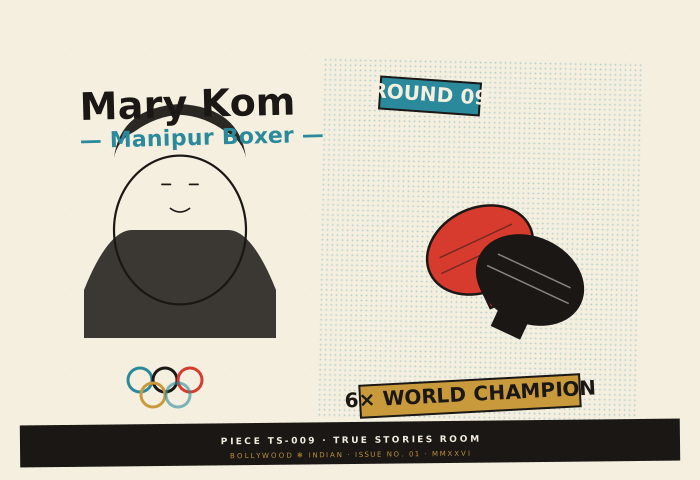
- Mangte Chungneijang Mary Kom: Born 1 March 1983 (some sources 1 March 1980) in Kangathei, Manipur.
- The records: Six-time AIBA Amateur Boxing World Champion (2002, 2005, 2006, 2008, 2010, 2018). 2012 Olympic Bronze Medal. Asian Games Gold 2014.
- The biopic: Mary Kom (2014). Directed by Omung Kumar. Starring Priyanka Chopra. Box office: ₹104 crores worldwide.
- The complications: Mary Kom herself had mixed feelings about the film. Pre-release she was supportive; post-release she remained ambivalent about creative choices.
Priyanka Chopra's 2014 Mary Kom biopic was the highest-grossing female-led Hindi film at its release. The boxer it was based on — MC Mary Kom, six-time World Amateur Boxing Champion from Manipur — had a complicated relationship with the film: nominally supportive, privately less enthusiastic. The film telescoped 15 years of her career into 2 hours and made several composite changes. Here is the actual life behind it.
ROUND 01 The early life
Mangte Chungneijang Mary Kom was born on 1 March 1983 (some sources cite 1980) in Kangathei, Churachandpur district, Manipur. She is from the Kom community — a small tribal group within Manipur. Her parents Mangte Tonpa Kom and Mangte Akham Kom were poor jhum cultivators.
She grew up in extreme rural poverty. Her early education at Loktak Christian Model High School involved long walks to school. She was an athletic child — sprinting, javelin, shot put — but no organised boxing programme existed in her region.
The first time she encountered boxing as a sport was in late 1999, when she was 16, after Manipur boxer Dingko Singh won gold at the 1998 Asian Games. The state government began promoting boxing locally. Mary Kom started training at the Anglo-Indian Boxing Centre in Imphal under coach M. Narjit Singh.
Her parents — particularly her father — initially opposed her boxing. Boxing was seen as a male sport with no future for women in India in 1999-2000. Mary Kom continued training despite this opposition, often hiding it from her family for the first year.
ROUND 02 The rapid rise (2000-2002)
Mary Kom's national rise was unusually fast. Within 18 months of beginning structured training, she was competing at national level. By 2001 (age 18) she had won the Indian Women's Amateur Boxing Championship. By late 2001, she was selected for the Indian team at the AIBA Women's Boxing World Championship — the first such tournament ever held.
At the 2001 World Championship in Scranton, Pennsylvania, Mary Kom won silver. She was 18.
The next year, at the 2002 AIBA Women's World Championship in Antalya, Turkey, she won her first gold. She was 19. From that point onwards, until 2008, she would either win or finish runner-up at every major international tournament she entered.
ROUND 03 The marriage and pregnancy (2005-2007)
Mary Kom married Karung Onkholer (called Onler) in 2005. Onler was a Manipuri footballer she had met years earlier. The marriage was supported by both families.
In 2007, she gave birth to twin sons. The film Mary Kom emphasised this — the central narrative tension of the film is whether she would return to boxing after motherhood. This was a real challenge. She lost approximately two years of competition time and faced doubts (from coaches, from herself) about whether she could return to her pre-pregnancy form.
She did. She won World Championship Gold in 2008, after recovering from twin pregnancy. She would win again in 2010 and (after another pregnancy in 2013) in 2018.
ROUND 04 The Olympic medal (2012)
Women's boxing was added to the Olympic programme for the first time at London 2012. Mary Kom qualified at the 51 kg flyweight category.
In the quarterfinal, she defeated Tunisia's Maroua Rahali. In the semifinal, she lost to Britain's Nicola Adams (who went on to win gold). Mary Kom received the bronze medal — the first Indian woman to win an Olympic medal in boxing.
This was the cinematic climax of her career to that point. The Mary Kom biopic ends approximately here.
ROUND 05 The film — Mary Kom (2014)
Omung Kumar's Mary Kom released on 5 September 2014. Priyanka Chopra played the lead role. The film was produced by Sanjay Leela Bhansali.
Box office: ₹104 crores worldwide, making it one of the highest-grossing Hindi films of 2014 and the highest-grossing female-led Hindi film at the time of release.
Production controversies that emerged:
- Casting choice: Priyanka Chopra, a Punjabi Indian, was cast to play Mary Kom, a North-East Indian from the Kom tribe. The "browned-up" appearance and prosthetic enhancements drew criticism for excluding Northeast Indian actresses.
- Geographic compression: The film shows much of the story unfolding in a vague "North Indian rural setting" rather than specifically in Manipur. Manipuri language and culture are downplayed.
- Composite characters: Several real coaches and family members were merged into single characters for narrative simplicity.
- The marriage timeline: The film compresses several years and reorders events for dramatic effect.
Mary Kom herself attended the premiere and made supportive public statements. In later interviews she expressed nuanced reservations — including about the Northeast representation question, and about specific scenes that conflated different real events.
ROUND 06 What the film got right
- The general arc of her life — rural Manipuri origins, opposition from her father, rapid rise, the boxing-vs-motherhood tension.
- The role of coach M. Narjit Singh in her early career.
- The marriage to Onler and the twin pregnancy.
- The overall trajectory through to the 2008 World Championship comeback.
- The financial struggle her family faced during her early competitive years.
ROUND 07 What the film got wrong or simplified
- The geographic erasure of Manipur. Manipur as a place barely figures in the film. The Kom tribal culture — her actual ethnic identity — is essentially absent.
- The casting decision. Northeast Indian audiences widely criticised the use of a non-Northeast lead.
- The political backdrop. Manipur's complicated political situation in the 1990s-2000s — the AFSPA, the insurgency, the everyday militarisation that shaped Mary Kom's childhood — is entirely absent.
- The role of Manipuri boxing culture. Dingko Singh's 1998 Asian Games gold was the catalyst for state-level boxing infrastructure; this context is invisible.
- The Olympic medal sequence. Mary Kom's 2012 bronze is dramatised but the actual political-cultural moment — first Indian woman boxing medal — is not contextualised against India's broader gender-and-sport history.
ROUND 08 The career after the film
The biopic ended approximately at her 2012 Olympic bronze. Mary Kom's actual career continued:
- 2014: Gold at Asian Games, Incheon — first Indian woman to win Asian Games boxing gold.
- 2016: Awarded Padma Bhushan (third-highest civilian award).
- 2018: Sixth World Championship gold at Delhi. Most decorated female boxer in World Championship history.
- 2020: Tokyo Olympics — failed to medal. Did not qualify for final medal positions.
- 2023: Announced retirement from competitive boxing.
She has served in the Rajya Sabha (Indian upper parliamentary house) from 2016. She runs the MC Mary Kom Regional Boxing Foundation in Imphal, training rural Manipuri children in boxing.
Six World Championship golds and one Olympic bronze. The most successful amateur boxer India has produced. The film tells about a sixth of her actual story.
For more from the true stories room, see Dangal's relationship with the real Phogat family which followed the Mary Kom template four years later, and the Bandit Queen story for an earlier biopic-controversy parallel.